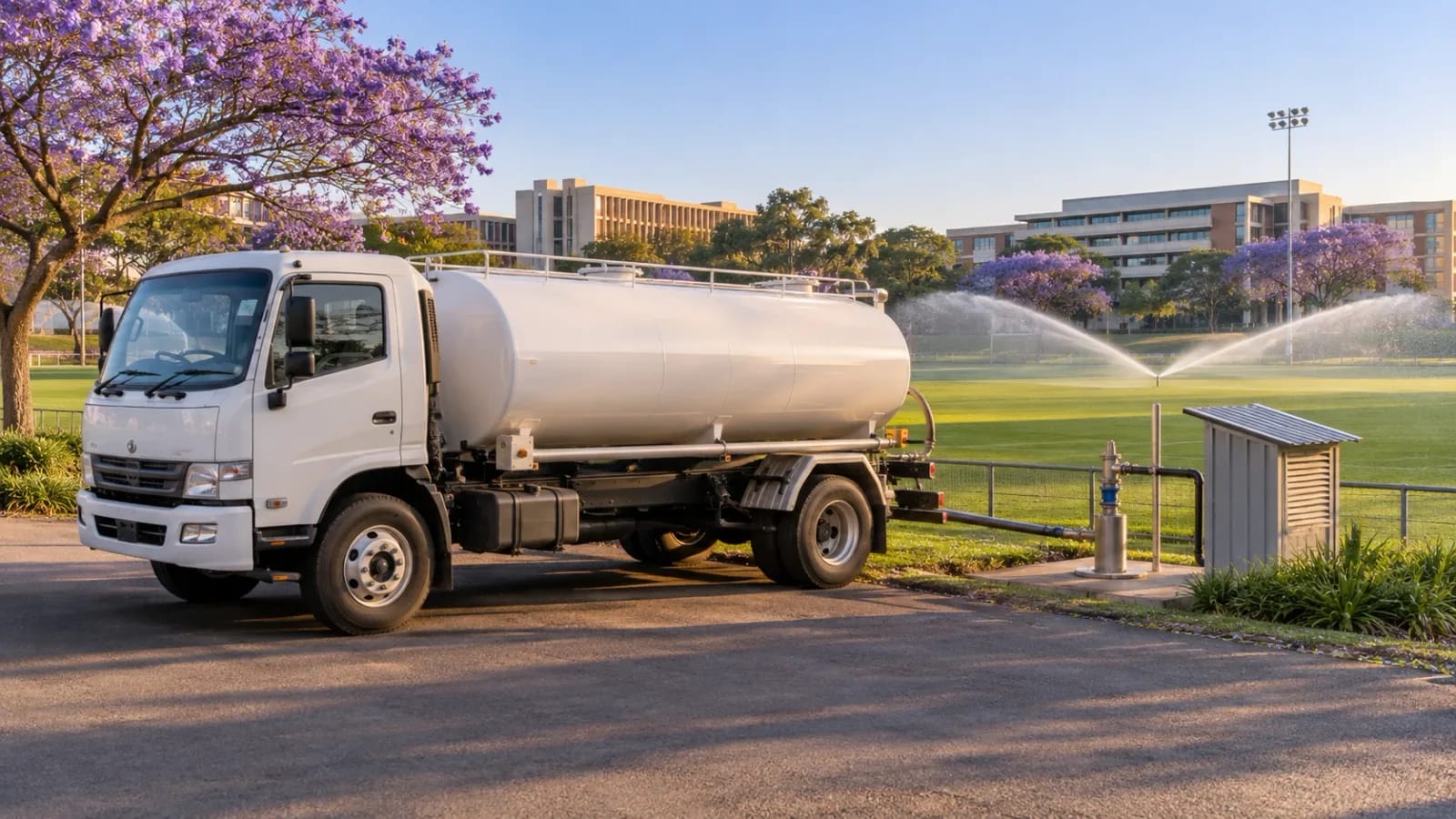
The University of Johannesburg (UJ) spent R15.15 million on 18.7 million litres of emergency water in its 2025 financial year, and the money went to commercial water suppliers, not to drilling. Headlines have linked the bill to UJ's boreholes, but those boreholes mainly irrigate grounds and sports fields. What ended the bill was a fleet of six of UJ's own water trucks.
The figures come from UJ's 2025 annual report and financial statements, as reported by Daily Investor. We haven't seen the report itself. For anyone running a school, estate, business park or farm in Gauteng, the useful part is how UJ layered its response.
What UJ Spent and Did
| Measure | Reported figure |
|---|---|
| Emergency bulk water bought | R15.15 million for 18.7 million litres, falling to zero by year-end |
| UJ's own tanker fleet | 6 trucks, 4,906 loads, 106 million litres moved between campuses in 2025 |
| Saving UJ reports from its fleet | R74 million, against buying that volume commercially |
| Greywater plant, commissioned 2024 | 4 million litres saved in 2025, worth R2.8 million |
| Water consumption | Down 5.6% in a year, and 32.1% from 2015 to 2025 |
| Boreholes | Supply four campuses, mainly irrigation and sports fields |
The report blames frequent outages, infrastructure failure and what it calls the City's "water shedding". UJ isn't alone in responding. Vaal University of Technology began installing boreholes across its campuses in 2025, and GroundUp reports that Johannesburg recorded 50,536 pipe leaks between June 2025 and June 2026, and that the City has spent at least R650 million on tankers over five years.
What the Boreholes Actually Do
The reporting doesn't say how many boreholes UJ has, and it doesn't describe them as a drinking water source. In effect, they take irrigation off the municipal supply, which leaves more of the available water for people.
That's a sensible split for a large site. Lawns and sports fields don't need drinking-quality water, so a borehole can serve them without a treatment plant. UJ also planned a 2026 project covering rehabilitation, certification and strategy for its boreholes, which is a reminder that they lose performance without upkeep. Our rehabilitation guide covers the signs and costs.
What Emergency Water Really Costs
The reported numbers let you work out a price per kilolitre. This is our arithmetic, not UJ's:
| Reported figures | Works out to |
|---|---|
| R15.15 million for 18.7 million litres | About R810 per kL |
| R8.1 million for 12.8 million litres (part of the same year) | About R630 per kL |
| R74 million saved on 106 million litres | About R700 per kL avoided |
At those prices, R100,000 buys roughly 125 to 160 kL of delivered water. That isn't a borehole payback figure: a borehole also needs a pump, power, testing and possibly treatment, and it only pays off if the ground yields water. It does show why sites that depend on tankers look for something else quickly. Tanker prices vary, and a homeowner's quote for a small load won't match a bulk contract. Our ROI calculator works through a household version.
Buying your own tankers isn't the lesson for most sites. Six trucks only make sense when you're moving 106 million litres a year between campuses. Most sites are better off with storage that carries them through an outage.
What Other Sites Can Copy
- Measure first. UJ ran a joint meter audit with the City to replace estimated bills, and it holds a R50.76 million provision for unbilled and under-billed utility charges. If your bill is an estimate, you can't plan around it.
- Cut demand before adding supply. A 32.1% drop in use over ten years is water UJ no longer has to find. Its greywater plant adds to that, with systems planned to recover a further 15 million litres a year.
- Match the water to the job. Use borehole or recycled water for irrigation and flushing, and keep treated water for drinking and kitchens.
- Plan for an outage, not just a bill. Size storage for the number of days you need to keep operating without the municipal supply.
The Rules for Non-Domestic Sites
A business, school or estate doesn't get the household exemption, so this is where sites get caught out.
- Register commercial boreholes. A DWS notice of 24 April 2026 (Government Notice 7408) called on unregistered commercial borehole users to register. The free window has closed, so a late fee of up to R300 per property may apply.
- Check your volume against your property size. The 2016 General Authorisation sets a yearly limit per hectare, which depends on your catchment. In the Vaal catchments C21 and C22 it's 75 m³ per hectare per year, so a 10-hectare site gets 750 m³ a year, or about 2 kL a day.
- Above the limit, you need a water use licence. The same applies within 100 m of a watercourse's riparian edge or 500 m of a wetland. A licence is a much bigger job and usually needs a geohydrologist.
- Check municipal rules too. Johannesburg has run a borehole application process through its Environment and Infrastructure Services Department since October 2025.
- Test before anyone drinks it. Use an accredited lab and compare the results with SANS 241. See our testing guide.
The reporting doesn't cover how UJ's boreholes are authorised, so we're not commenting on that. This is general information, not legal advice. Our registration guide has more detail.
If You're a Homeowner
The same logic works at a smaller scale, with simpler rules: reasonable household use falls under Schedule 1 and doesn't need DWS registration, though municipal rules may still apply. A common setup is a borehole feeding a storage tank, with the tank carrying the house through outages and the garden running on untreated borehole water. Start with the 2026 price guide, or request a free quote.
FAQ
Did UJ spend R15.15 million on boreholes?
No. As reported, that amount bought 18.7 million litres of emergency water from commercial suppliers. The reporting gives no cost for the boreholes.
Does UJ drink its borehole water?
The reporting describes the boreholes as primarily irrigating grounds and sports fields. It doesn't describe them as a drinking water source.
Can a business in Johannesburg just drill a borehole?
Not without checking the rules. Commercial use has to be registered with DWS, your property size and catchment set how much you can take under the General Authorisation, and Johannesburg has its own application process.
Ready to Start Your Borehole Project?
Connect with verified contractors in your area. Get a free site assessment and personalised quote.