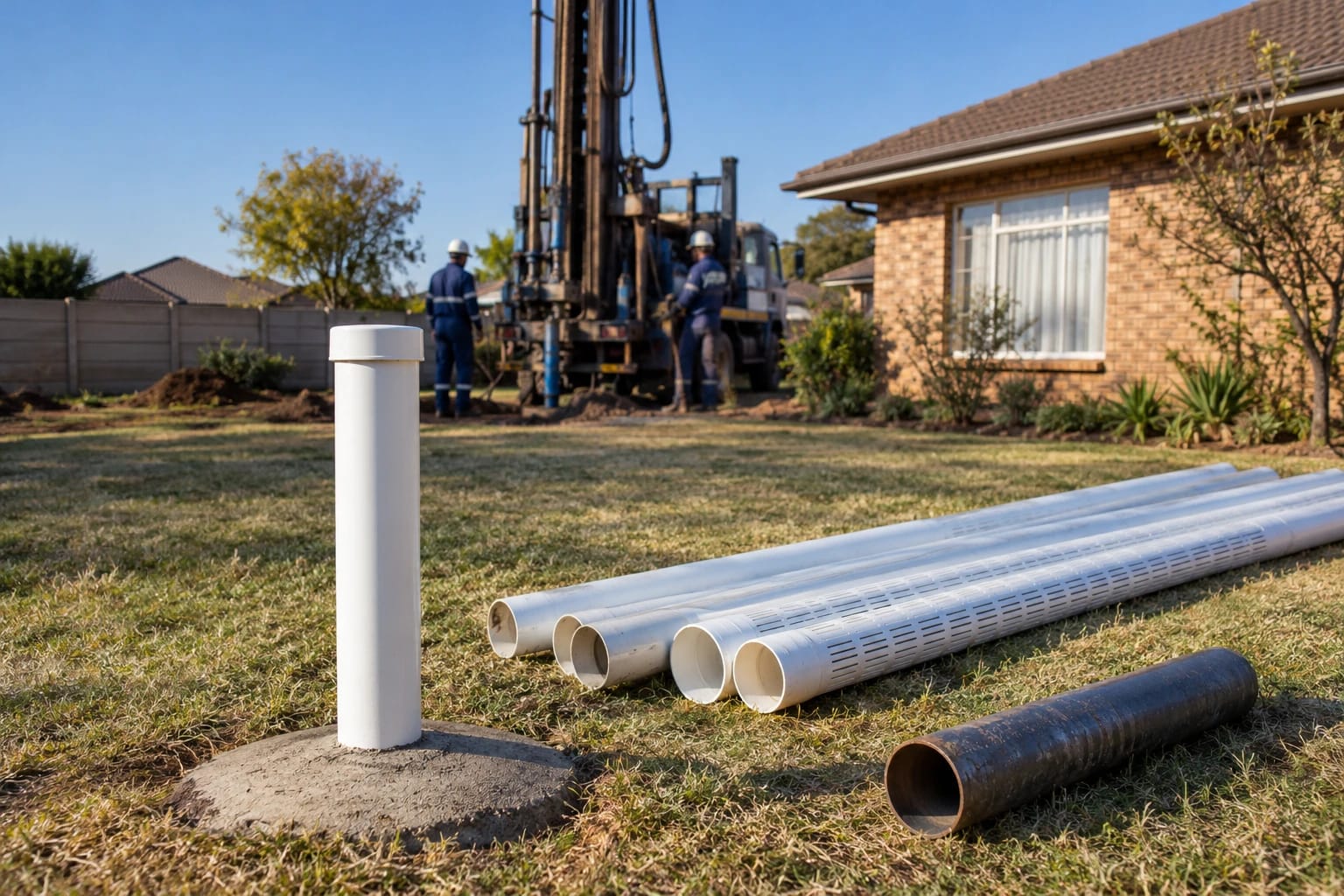
Casing is the pipe that lines a borehole. It is one of the line items homeowners skim past on a quote, yet it decides whether the borehole stays open, whether sand ends up in your pump, and whether surface water can run straight down into your drinking water. It is also one of the easier costs to compare between contractors, because casing has a published retail price.
This guide explains what casing does, when PVC is enough and when you need steel, which diameter you need, and what it costs in 2026.
What Borehole Casing Does
- Keeps the hole open. The soft, weathered ground near the surface collapses if it is left unsupported.
- Keeps sand and silt out. Slotted (perforated) casing at the water-bearing zone lets water in while holding back loose material, which protects the pump.
- Seals out surface water. Casing plus a cement or bentonite seal around the top stops rainwater, stormwater and septic seepage running down the outside of the pipe into the aquifer.
How much casing a borehole needs depends on the geology. In hard rock, casing usually runs through the soft top layer down to solid rock, and the hole below stays open. In sand, clay or weathered formations that keep collapsing, casing runs the full depth, with slotted lengths where the water comes in.
PVC vs Steel Casing
| uPVC casing | Steel casing | |
|---|---|---|
| Cost | Lower | Higher, roughly two to three times PVC per metre |
| Corrosion | Doesn't rust | Can corrode in acidic or salty water |
| Strength | Enough for most domestic boreholes | Stands up to collapsing ground and drilling through boulders |
| Typical use | Full-depth lining in soft formations; most residential boreholes | The top section through unstable overburden; deep or high-pressure holes |
Many residential boreholes use both: a short length of steel through the unstable surface layer, and PVC below it. PVC comes in pressure classes. A higher class means a thicker wall. Class 9 is the common choice for domestic boreholes, and Class 12 is used where the casing has to withstand more pressure.
Borehole Casing Prices in 2026
PVC casing is sold in 6 m lengths. These are retail prices for Class 9 casing listed by a South African pump retailer in October 2026:
| Diameter | Solid, per 6 m | Slotted, per 6 m | Per metre |
|---|---|---|---|
| 110 mm | R512 | R627 | R85–R105 |
| 125 mm | R551 | R740 | R92–R123 |
| 140 mm | R663 | R871 | R110–R145 |
| 165 mm | R746 | R1,103 | R124–R184 |
Steel casing (177 mm) came in at R350 per metre on a 2026 installer quote we sourced for our price guide.
Installed casing is quoted per metre and includes labour, couplings, gravel pack and the surface seal. 2026 rate benchmarks put installed PVC at about R400–R550 per metre and installed steel at about R600–R700 per metre. That is why the casing line on a quote is several times the cost of the pipe itself.
Retail prices change. The PVC prices above were on special when we checked; the listed normal prices were 10–65% higher. Use them to sanity-check a quote, not as a fixed price.
Which Casing Diameter You Need
The casing has to be wide enough for the pump, its rising main and cable, with room to lift the pump out later. Most residential boreholes are cased at 140–165 mm. That fits a standard 4-inch (about 100 mm) submersible pump with clearance. 110–125 mm casing suits 3-inch pumps and low-volume domestic use, but it limits which pumps you can fit later.
If you might ever want a bigger pump, for irrigation or a second dwelling, case at 165 mm now. Re-casing later costs far more than the difference in pipe. Our pump price guide lists pump sizes alongside real prices, and our guide to borehole depths shows how much casing your area is likely to need.
Worked Example: Casing a 60 m Borehole
Take a 60 m borehole cased its full depth in 165 mm Class 9 PVC, with 12 m of slotted casing at the water-bearing zone:
- 8 solid lengths × R746 = R5,970
- 2 slotted lengths × R1,103 = R2,206
- Pipe only: about R8,200
Installed, at R400–R550 per metre, the same 60 m comes to R24,000–R33,000. That matches the casing range in our 2026 price guide. In hard rock, where only the top section needs casing, the bill is much smaller.
What Your Quote Should Say About Casing
A proper quote lists the casing on its own line. Check that it gives:
- Material and class: uPVC Class 9, Class 12, or steel, and how many metres of each.
- Diameter: the casing's outside diameter in millimetres.
- Solid and slotted lengths: how many metres of each, and where the slotted section goes.
- Gravel pack and seal: whether the gap around the casing is packed, and whether the top is sealed with cement or bentonite.
- Whether it's a provisional sum: casing depth often isn't known until drilling, so many contractors quote a rate per metre. Make sure the rate is written down.
A quote that says only "casing as required" leaves the biggest variable open. Ask for the per-metre rate before drilling starts. Our guide to choosing a contractor covers the other questions to ask.
Sources: PVC casing retail prices from SuperPump, checked October 2026. Installed casing rates from DrillBuilders' 2026 rate benchmarks. Steel casing rate from a 2026 installer quote used in our price guide. Prices vary by supplier and region; confirm current prices before buying.
Ready to Start Your Borehole Project?
Connect with verified contractors in your area. Get a free site assessment and personalised quote.