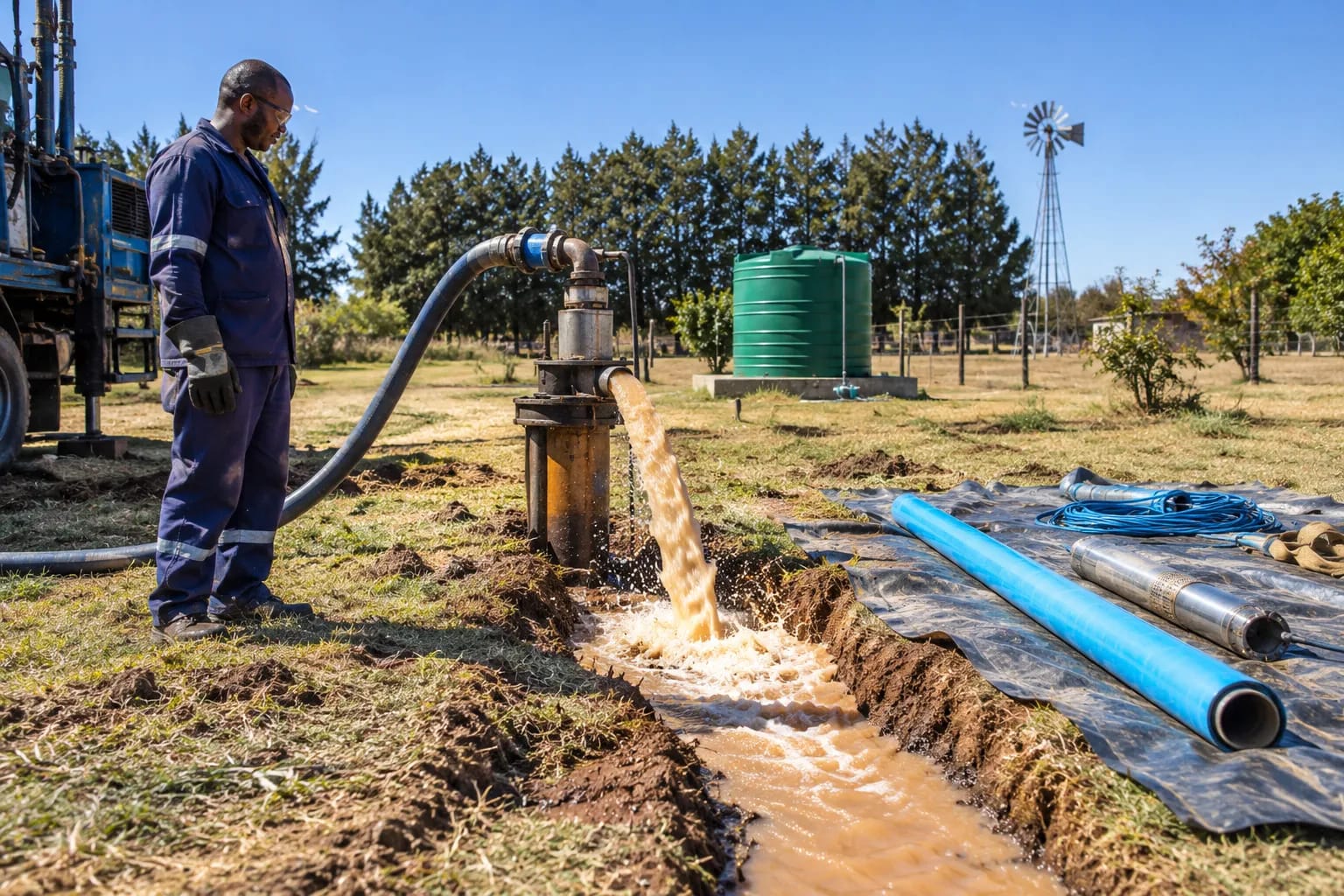
Boreholes rarely fail overnight. Usually the flow drops a little each season, the water turns cloudy after heavy pumping, or the pump starts tripping. Often the borehole isn't finished at all. Sand, silt, mineral scale or iron bacteria have built up in the casing and the rock around it, and they can be cleaned out for a fraction of the cost of a new borehole.
Signs Your Borehole Needs Attention
- Sand or silt in the water, especially when the pump starts. It also wears out the pump quickly.
- Flow or pressure dropping gradually over months. That often points to silting or scale build-up.
- The pump running dry or cutting out, because the water level now falls below the pump inlet.
- Orange, brown or black water, slime or a rotten-egg smell. These are typical signs of iron, manganese or iron bacteria.
- Water stopping suddenly. That's more often electrical: a failed control box, a damaged cable or a burnt-out pump.
Diagnose Before You Pay for Cleaning
Different problems need different fixes, and some aren't the borehole's fault at all. Before agreeing to a rehabilitation package, ask for:
- A pump and electrical check. Pull the pump and test the motor, cable and control box. Sudden failures are usually here.
- A downhole camera inspection. A camera shows sand build-up, scale, blocked slots, or damaged and collapsed casing. It turns guesswork into a quote for a specific fix.
- A water level and yield check. Compare it with the original yield test, if you have one.
- A water test if the colour, smell or taste has changed.
Flushing and Rehabilitation Methods
| Method | What it does | Used for |
|---|---|---|
| Flushing / air-lifting | Compressed air lifts water and loose sediment out of the hole | Sand and silt build-up |
| High-pressure jetting | Water jets clean the casing slots and the gravel pack | Clogged slotted casing, stubborn sediment |
| Surging / re-development | Pushes water back and forth through the slots to loosen fines | Falling yield after years of use |
| Chemical treatment | Acid dissolves scale; chlorine or other treatments kill bacteria | Mineral scale, iron bacteria, slime |
| Structural repair | Relines damaged casing or seals leaks | Cracked, corroded or collapsed casing |
Most jobs combine two or three of these: for example, a chemical treatment followed by a flush, then a water test to confirm the result.
What Flushing and Rehabilitation Cost in 2026
There's no official price list. These are indicative ranges published by Gauteng contractors in 2026:
| Service | Typical range |
|---|---|
| Camera inspection | R2,500–R6,000 |
| Pump pull, inspect and reinstall | R4,000–R10,000 |
| Basic sand and silt flushing | R5,000–R15,000 |
| Chemical treatment | R5,000–R15,000 |
| Re-development (jetting or surging) | R5,000–R20,000 |
| High-pressure jetting | R10,000–R25,000 |
| Structural repair (casing damage, leaks) | R15,000–R50,000+ |
| Pump replacement, installed | R15,000–R35,000 |
Depth, access and how badly the borehole is clogged decide where your job lands. A shallow borehole with loose sand sits at the bottom of the range. A deep borehole with heavy scale and damaged casing sits at the top. Get the scope of work in writing, and ask what happens to the price if the first method doesn't work.
Compare that with a new borehole. A new 60 m borehole costs about R65,000–R150,000 all-in (see our 2026 price guide). Even a thorough rehabilitation is usually well under half of that.
Rehabilitate or Drill a New Borehole?
Rehabilitation usually makes sense when the borehole once had a good yield, the casing is sound or repairable, and the camera shows clogging rather than collapse.
Drilling new is usually better when the casing has collapsed along much of its length, the aquifer itself has dropped (neighbours' boreholes are failing too), or the original borehole was poorly sited and never yielded well. A hydrogeologist can tell you whether a deeper or relocated borehole is likely to do better.
Keeping It from Happening Again
- Size the pump from a yield test, not the blow yield measured during drilling. Over-pumping draws sand in and drops the water level onto the pump.
- Set the pump at the right depth, above the bottom of the hole, where sediment collects.
- Pump into a storage tank so the borehole runs in steady cycles, rather than starting and stopping with every tap.
- Test the water every year and act early on iron or bacteria.
- Follow a maintenance routine. Our maintenance checklist covers the monthly and annual checks.
Need a borehole inspected or cleaned? Request a quote and we'll put you in touch with a provider near you, or browse the directory.
Sources: indicative 2026 prices published by WaterQuotes (September 2026) and Enviroleg. Contractor-published ranges, not a regulated tariff. Always get a written quote for your specific borehole.
Ready to Start Your Borehole Project?
Connect with verified contractors in your area. Get a free site assessment and personalised quote.