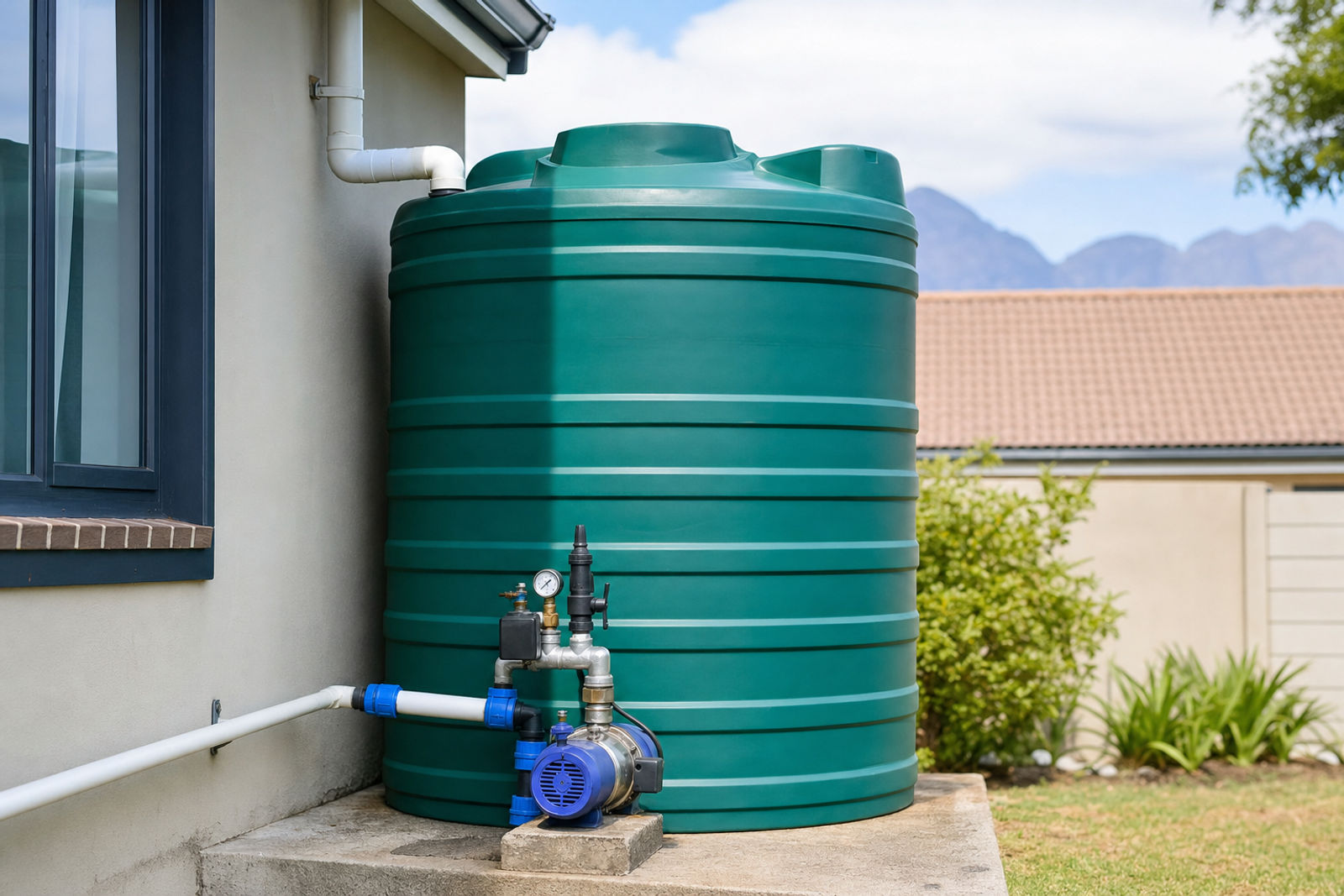
The standard borehole setup — pump straight to a pressure system — works, but it has a significant weakness: you're entirely dependent on the pump being operational whenever you want water. Load shedding, pump maintenance, or a dry-run event means no water. Adding a JoJo (or similar polyethylene) storage tank changes the equation completely.
Why the Borehole + Storage Tank Combo Is the Gold Standard
A storage tank between the borehole pump and your household supply creates a buffer that solves South Africa's three biggest water reliability problems:
- Load shedding: The pump fills the tank whenever there's electricity (or sunlight, if solar-powered). When load shedding hits, you draw from the stored water — no interruption.
- Pump maintenance: If the submersible pump needs service (a day or two offline), you still have stored water. Without a tank, a pump service means no water at all.
- Low-yield boreholes: If your borehole only yields 0.3–0.5 l/s, filling a tank slowly throughout the day gives you much more total water than a pump-to-tap system would, which can struggle to maintain pressure during peak demand.
How a Borehole + JoJo Tank System Works
A complete borehole-to-tank setup has the following components in sequence:
- Borehole submersible pump — pushes water up the rising main to the surface
- Surface pipework — delivers water from the borehole head to the tank
- JoJo storage tank — stores the pumped water (typically elevated on a stand, or at ground level if a transfer pump is used)
- Float switch — automatically stops the borehole pump when the tank is full, protecting against overflow and dry-running
- Transfer/pressure pump (or gravity, if tank is elevated) — delivers water from the tank to your house at the right pressure
- Filtration system (recommended) — UV steriliser and sediment filter inline before the house supply
- Bypass valve (optional) — allows switching between borehole and municipal supply, useful during borehole maintenance periods
What Size JoJo Tank Do You Need?
Size your tank based on:
- Daily water consumption — average SA household uses 600–1,200L/day (150–300L/person/day)
- Buffer requirement — typically 2–3 days' consumption as reserve
- Borehole fill rate — a 2,500L tank filled in 2 hours by a strong borehole needs much less capacity than a slow-yield borehole that trickles in over 8 hours
Recommended sizes by household:
- 2 people, small garden: 2,500L
- 3–4 people, medium garden: 5,000L
- 4–6 people, large garden or pool: 10,000L
- Farm or smallholding: 20,000L–50,000L
JoJo tanks come in vertical and horizontal configurations. Vertical tanks take up less footprint but require a sturdy stand if you want gravity-fed supply. Horizontal tanks can be buried underground for a discreet installation in suburban settings.
System Costs — What to Budget
Adding a JoJo tank system to a standard borehole installation adds R15,000–R40,000 depending on tank size, stand requirements, and whether a separate pressure pump is needed.
- 2,500L JoJo tank: R3,500–R5,000
- 5,000L JoJo tank: R6,500–R9,000
- 10,000L JoJo tank: R12,000–R17,000
- Steel stand (for elevated installation): R3,000–R8,000
- Pressure pump (booster): R3,500–R12,000
- Float switch, pipework, fittings, installation labour: R4,000–R10,000
- Basic UV + sediment filtration: R5,000–R12,000
Total cost for a complete mid-range borehole + 5,000L tank + pressure pump + basic filtration system: approximately R75,000–R130,000. Use our ROI Calculator to see how quickly this pays back against your current municipal bill.
Installation Tips to Get Right
- Tank placement: If using gravity feed (no pressure pump), position the tank as high as possible — every 10m of height gives approximately 1 bar of pressure. Most homes need 2–3 bar; you'd need a 20–30m elevated tank for full pressure, which usually isn't practical. A booster pump is more realistic.
- Float switch: Never skip this. It should cut power to the borehole pump when the tank is full AND trigger an alert when the tank drops below a set level. Get a two-level float switch, not a single-level one.
- Overflow pipe: Install an overflow at 90% tank capacity and route it safely to a stormwater drain or garden. Tanks that overflow next to the foundation cause serious damp problems.
- Bypass valve: Install a 3-way valve so you can easily switch your house plumbing between borehole and municipal supply. This makes borehole maintenance seamless.
- Filtration before house entry: Install at minimum a 5-micron sediment filter and UV steriliser on the line from the tank to your house. This protects appliances and ensures water safety regardless of tank condition.
Frequently Asked Questions
Can I connect a JoJo tank to both borehole and municipal supply?
Yes — this is the recommended setup. A non-return valve and 3-way valve lets you fill the tank from either source. During normal operation, the borehole fills the tank. During borehole maintenance or a dry period, you switch to municipal top-up. This gives you total water security regardless of any single source failing.
Do I need planning permission for a JoJo tank in my garden?
In most municipalities, tanks under 10,000L on private property don't require planning permission. Tanks above this size, or those visible from the street, may require council approval. Check with your local municipality before installation if you're unsure.
How do I keep my JoJo tank water clean?
Keep the tank lid sealed (block mosquitoes and prevent algae). Inspect and clean the tank interior every 1–2 years. Use a UV steriliser on the outlet line to the house. Avoid letting the tank sit stagnant for weeks — circulation from daily use keeps the water fresh. If the tank has been stagnant for more than 2 weeks, shock-dose with sodium hypochlorite (pool chlorine) before use.
What brand of tank is best — JoJo, Roto, or Safari?
JoJo is the most established brand in South Africa with the widest service and parts network — the safest choice for most applications. Roto Tanks and Safari Tanks are credible alternatives at similar price points. All major brands use UV-stabilised polyethylene. Avoid unbranded imported tanks — they often lack UV stabilisation and crack within 2–3 years of sun exposure.
Ready to Start Your Borehole Project?
Connect with verified contractors in your area. Get a free site assessment and personalised quote.
Related Guides
Related Articles
The Gautrain Borehole Incident: What Every SA Homeowner Must Know Before Drilling
In February 2025, an unauthorised borehole in Killarney caused R1 million in Gautrain tunnel damage and a 10-day service suspension. Here's what the law actually requires — and how to drill safely and legally in 2026.
Getting StartedTop 5 Reasons Why a Borehole is the Best Investment for Your SA Home
From water independence and cost savings to increased property value, here's why thousands of South African homeowners are investing in boreholes — and how to calculate your potential return.
Getting StartedHow to Register a Borehole in South Africa — DWS Step-by-Step Guide
Everything you need to know about registering your borehole with the Department of Water and Sanitation. Who needs a permit, what it costs, and exactly how to do it — step by step.