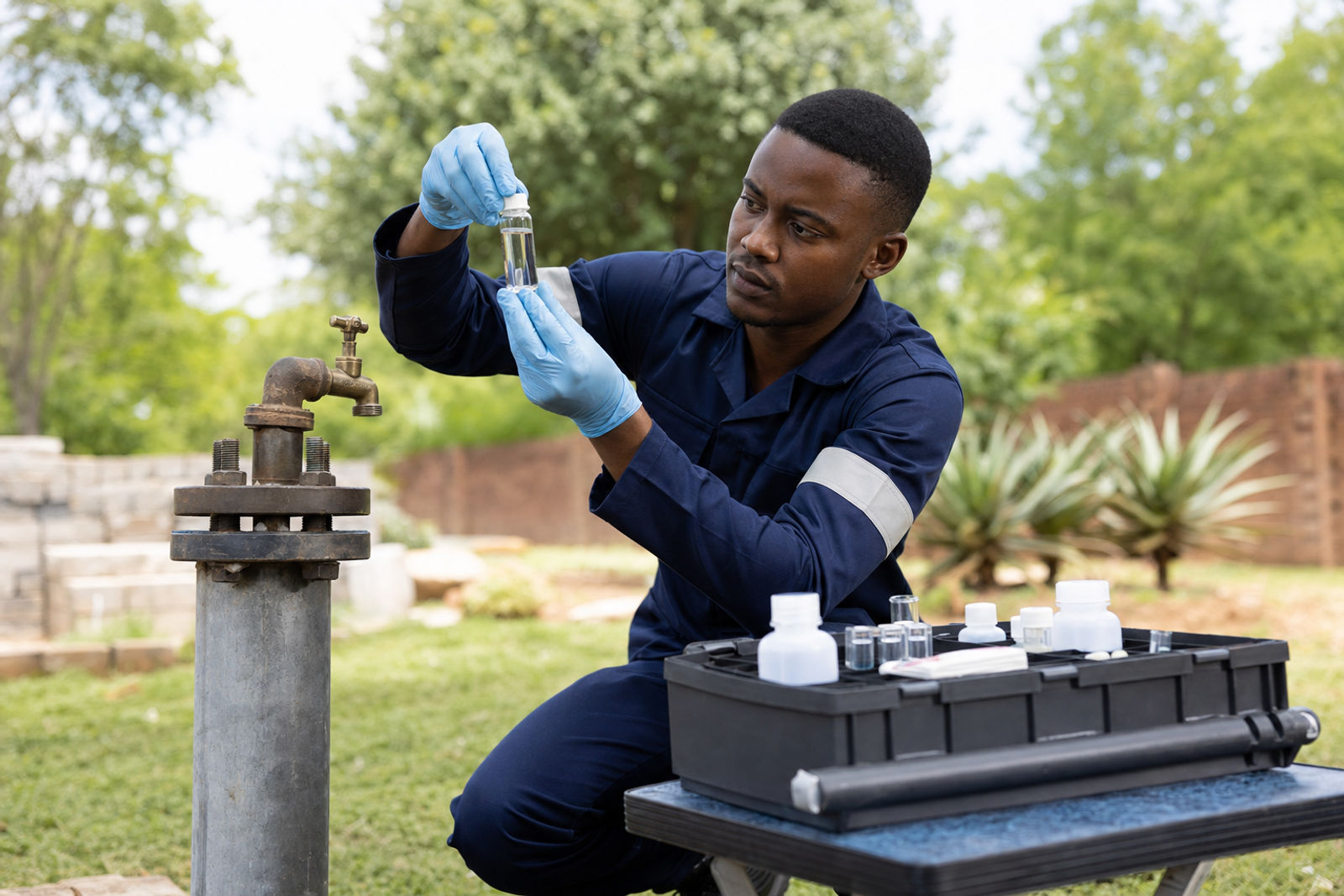
The single most important thing you can do after drilling a borehole — before using the water for anything domestic — is have it tested. South African groundwater quality varies enormously by geology, land use history, and proximity to industrial or agricultural activity. This guide tells you exactly what tests to run, when to run them, and what to do with the results.
Why You Must Test Your Borehole Water
Borehole water is not automatically safe. Unlike municipal water, which is treated and monitored continuously, groundwater contains whatever it picks up on its journey through the earth. That can include:
- Bacteria and pathogens: E. coli, coliforms, and other micro-organisms from septic tanks, agricultural runoff, or natural soil bacteria
- Heavy metals: Iron, manganese, arsenic, and lead — elevated in many South African rock formations
- Nitrates: From fertilisers and septic system leachate — particularly dangerous for infants
- Fluoride: Naturally elevated in parts of Limpopo, Free State, and Northern Cape
- Hardness: High calcium and magnesium causing scale buildup in geysers, pipes, and appliances
- pH imbalance: Highly acidic water corrodes pipes and plumbing fittings
SANS 241 — South Africa's Drinking Water Standard
The South African National Standard SANS 241 defines the requirements for safe drinking water. It covers microbiological, physical, and chemical parameters. Any laboratory testing your water for domestic use should test against SANS 241 Class 1 limits.
Key limits to know:
- E. coli: 0 per 100mL — any presence is a fail; the water is not safe to drink
- Total dissolved solids (TDS): max 1,200 mg/L — above this tastes unpleasant and may have health implications
- Iron: max 0.3 mg/L — commonly exceeded in granite areas; causes staining
- Nitrates: max 11 mg/L as N — exceeding this is dangerous for infants
- pH: 5.0–9.7 — outside this range is corrosive or scale-forming
What to Test For — Recommended Test Packages
Basic Microbiological Test (R400–R800)
E. coli and total coliform count. Minimum requirement before using any borehole water for drinking or cooking. Should be the first test after drilling and annually thereafter.
Standard Residential Package (R1,200–R2,500)
Microbiological + key physical/chemical parameters: pH, TDS, conductivity, iron, manganese, nitrates, fluoride, hardness. Covers the most common problem parameters for residential use in South Africa. Recommended for all new boreholes.
Full SANS 241 Panel (R2,500–R5,000)
Tests 40+ parameters including all heavy metals, full microbiological suite, organic compounds, and physical parameters. Required for Water Use Licence applications and recommended for any borehole used for drinking or cooking on a property being sold.
Agriculture-Specific Panel (R2,000–R4,000)
Tests for parameters that affect crop growth and livestock health: sodium adsorption ratio (SAR), specific ions (boron, chloride), electrical conductivity. Required if you're irrigating food crops or watering animals.
When to Test
- ✅ Immediately after drilling — before using the water for anything
- ✅ Annually — bacterial contamination can develop over time
- ✅ After any flooding in the area — floodwater can introduce surface contamination
- ✅ After nearby construction — drilling, excavation, or blasting can disturb aquifers
- ✅ If the water changes in appearance, taste, or smell
- ✅ Before selling your property — buyers increasingly require a current test certificate
- ✅ After any borehole rehabilitation or pump work
How to Take a Correct Water Sample
A botched sample gives useless results. For a valid microbiological test:
- Get a sterile sample bottle from your testing laboratory (or pharmacy — some stock them)
- Let the pump run for at least 10 minutes before sampling — this flushes standing water from the pipe
- Do not sample from an outdoor tap if the water sits in a long pipe exposed to sunlight (bacteria multiply in warm standing water)
- Do not touch the inside of the bottle or cap
- Fill to the line indicated (usually 100mL) without overfilling
- Get the sample to the laboratory within 4 hours, kept cool (4–8°C)
For chemical tests, the same flushing protocol applies. Chemical samples are less time-sensitive — most labs accept them within 24 hours if kept cool.
What to Do If Your Water Fails a Test
Bacterial Failure (E. coli or Coliforms Detected)
Shock chlorinate the borehole immediately. This involves adding a calculated volume of sodium hypochlorite (pool chlorine) to the borehole water column, leaving it for 12–24 hours, then flushing until chlorine smell is gone. Re-test after 48 hours. If re-contamination occurs, investigate the source — often a faulty borehole seal, nearby septic tank, or casing crack. Read our filtration guide for UV treatment options.
High Iron or Manganese
Common in granite areas and not dangerous at mildly elevated levels, but causes staining and affects taste. Solutions include birm filter media, aeration systems, or chemical dosing. A borehole service specialist can advise on the appropriate treatment based on your iron concentration.
High Nitrates
Cannot be removed by standard filtration. Reverse osmosis (RO) is the most effective treatment for nitrate removal. High nitrates (above 11 mg/L as N) mean the borehole water should not be used for infant formula or drinking by young children until an RO system is installed.
Low pH (Acidic Water)
Calcite or soda ash contact filters raise pH and protect your plumbing. Highly acidic water (pH below 5.5) will corrode copper pipes within a few years — address this before connecting to your household plumbing system.
Frequently Asked Questions
Where do I send my borehole water sample for testing in South Africa?
SANAS-accredited laboratories across South Africa test water to SANS 241 standards. In Gauteng: Talbot Labs (Randburg), Waterlab (Pretoria), and Bemlab are commonly used. In the Western Cape: Waterlab, Bemlab, and Innolab. Ask your borehole contractor for a recommendation — most have a preferred lab relationship and can arrange sample collection.
How long does borehole water testing take?
Microbiological tests take 24–48 hours. Chemical panels take 5–10 working days. Full SANS 241 panels can take 10–15 working days. Most labs offer a 24-hour express service for microbiological tests at a small additional fee.
Can I use borehole water for a swimming pool without testing?
Yes — pool water is treated with chlorine, so microbiological safety is less of a concern. However, very high TDS, iron, or hardness can affect pool chemistry and cause staining. A basic physical/chemical test (not microbiological) is sufficient for pool-only use.
My borehole water tastes different from municipal water — is it safe?
Different doesn't necessarily mean unsafe. Borehole water often tastes different because it lacks the chlorine treatment of municipal water and may have different mineral content. Only a test can confirm safety. Many people prefer the taste of well-tested borehole water over municipal water once they know it's clean.
Ready to Start Your Borehole Project?
Connect with verified contractors in your area. Get a free site assessment and personalised quote.
Related Guides
Related Articles
Is Your Borehole Water Safe to Drink? A Complete Filtration Guide
From UV sterilisation to reverse osmosis, we compare every filtration option available to turn raw borehole water into pure drinking water — with specific recommendations based on your area's geology and common contaminants.
GuidesHow to Finance a Borehole in South Africa: Cash, Home Loan, or Personal Loan?
A complete guide to borehole financing options in SA — home loan readvance, personal loans, pension-backed loans and cash. Real 2026 rates from FNB, Absa, Nedbank and Capitec compared.
Getting StartedThe Gautrain Borehole Incident: What Every SA Homeowner Must Know Before Drilling
In February 2025, an unauthorised borehole in Killarney caused R1 million in Gautrain tunnel damage and a 10-day service suspension. Here's what the law actually requires — and how to drill safely and legally in 2026.