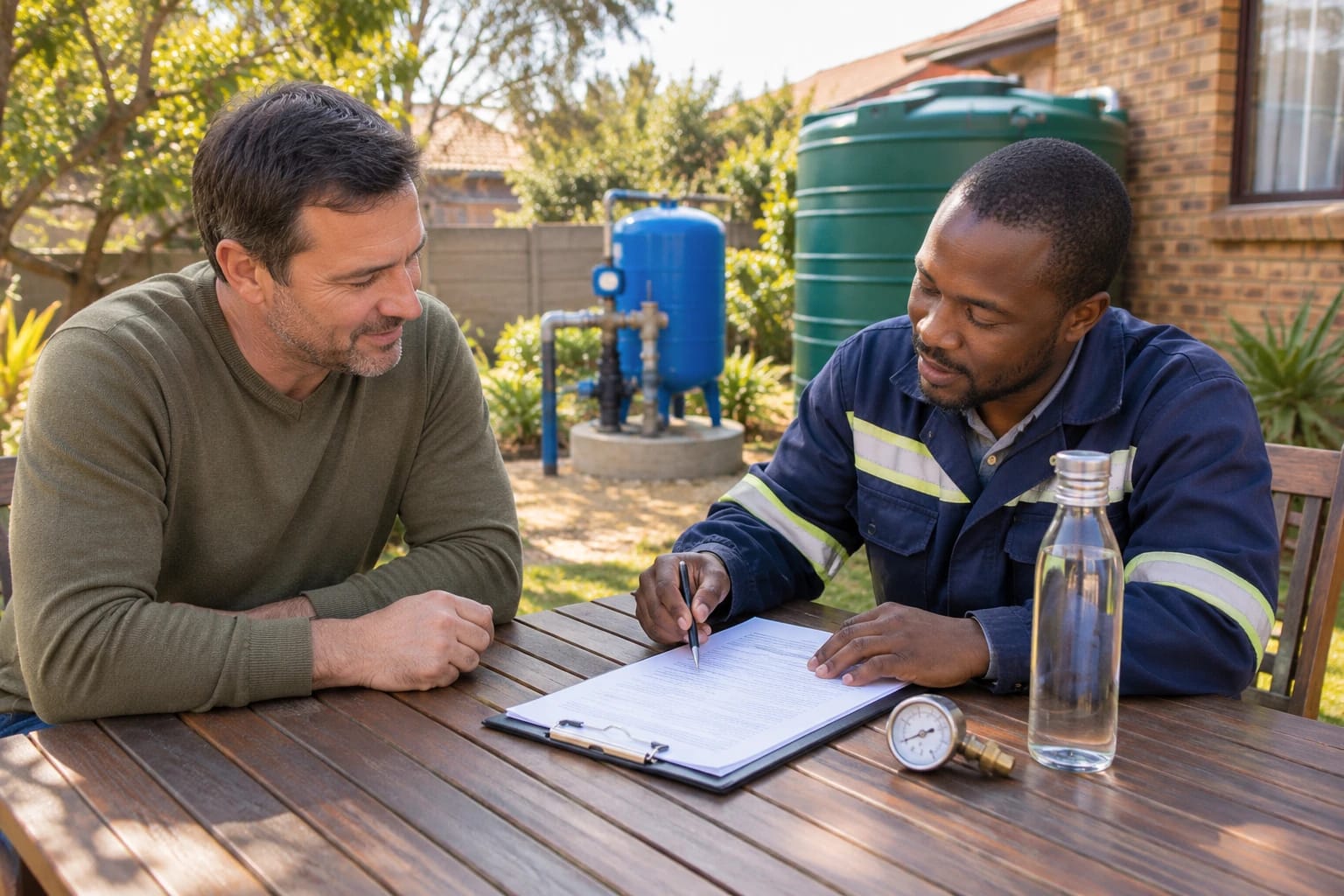
"Borehole certificate" is one of the most searched borehole terms in South Africa, usually by someone selling a house, buying one, or applying for a bond. The confusing part is that no single document carries that name. What people mean is a set of up to four documents, each answering a different question about the borehole.
There's No Single Borehole Certificate
| Document | Answers | Who issues it | Typical cost |
|---|---|---|---|
| Driller's report | How was it built? | The drilling contractor | Included in drilling |
| Yield test certificate | How much water can it safely give? | A yield testing contractor | R2,500–R6,000 |
| Water quality report | Is the water safe to drink? | An accredited laboratory | R1,200–R5,000 |
| Registration | Is it legal? | Your municipality and/or DWS | Often free; depends on use |
1. The Driller's Report (Completion Report)
A good drilling contractor hands over a completion report, sometimes called a borehole log, when the job is done. It records:
- The final depth and diameter
- The casing used: material, length, and where the slotted section is
- The depths where water was struck, and the rock types drilled through
- The "blow yield": a rough first estimate of flow, measured while drilling
It costs nothing extra, so ask for it in writing before you pay the final invoice. Without it, a future buyer, pump installer or hydrogeologist is guessing about what's underground.
2. The Yield Test Certificate
This is the document most people mean by "borehole certificate". A yield test pumps the borehole at a measured rate for several hours and records how far the water level drops and how quickly it recovers. The certificate then states the sustainable yield in litres per hour, and usually a recommended pump depth and pumping rate.
Drillers generally test against SANS 10299-4, the South African standard for test pumping. A basic domestic test runs about 4–24 hours, and fuller tests run 48 hours or more. Larger or commercial uses call for longer step and constant-rate tests. Expect to pay around R2,500–R6,000. Our guide to yield testing explains how to read the results.
Why it matters: the blow yield measured during drilling usually overstates what a borehole can deliver day after day. A pump sized on the blow yield can run the borehole dry and burn out. The yield test is what the pump should be sized on.
3. The Water Quality Report
A laboratory accredited by SANAS tests a sample against SANS 241, South Africa's drinking-water standard. A domestic test checks for bacteria such as E. coli, plus chemical and physical results like nitrates, iron, manganese, fluoride, pH and hardness. A standard residential package costs about R1,200–R2,500, and a full SANS 241 panel R2,500–R5,000.
A water report is a snapshot. Retest every year, after floods, and whenever the taste, smell or colour changes. See our water testing guide for what to ask the lab for.
4. Registration with Your Municipality and DWS
Registration is about permission, not the borehole's condition, and the rules come from two levels:
- Your municipality. Rules differ by city. The City of Cape Town requires boreholes and wellpoints to be registered. Ekurhuleni requires permission before drilling. Johannesburg's health by-laws let the city ask for borehole details and proof that the water is safe.
- The Department of Water and Sanitation (DWS). Reasonable domestic use falls under Schedule 1 of the National Water Act and, as DWS confirmed in 2026, needs neither a licence nor registration. Larger uses, such as irrigation or commercial use, need registration under a General Authorisation or a water use licence.
Our DWS registration guide walks through the forms and thresholds.
Selling or Buying a House with a Borehole
As conveyancing attorneys at Snyman Inc point out, a borehole certificate isn't required by law when a property is sold. But two things often make one necessary in practice:
- The sale agreement. The offer to purchase can make a yield test or water test a condition of the sale, and say who pays for it.
- The bank. Many banks ask for borehole certificates before approving a bond, especially when the borehole is the property's main water supply.
Selling? Gather the driller's report, a yield test from the last few years, a recent water report and any registration paperwork before you list. It answers buyers' questions early and avoids a last-minute test holding up transfer.
Buying? Ask for all four documents. If the yield test is old or missing, make a new one a condition of your offer. Also ask how old the pump is, and when the borehole was last serviced.
If the Paperwork Is Missing
Most older boreholes have no paperwork at all. That's fixable:
- Ask the original drilling company. Many keep records by address.
- Have a new yield test done. It gives you a current certificate whatever happened before.
- Send a sample to an accredited lab for a SANS 241 water test.
- Register with your municipality if your city requires it.
- If the depth or condition is unknown, a downhole camera inspection shows the casing, depth and any blockages.
Need a yield test, water test or inspection? Request a quote and we'll put you in touch with a provider near you, or browse the directory.
Sources: Snyman Inc Attorneys, "Is a Borehole Certificate Required When Selling Your Property?" (December 2024). Costs from our registration guide and 2026 price guide. This article is general information, not legal advice. Check your municipality's current by-laws and your sale agreement.
Ready to Start Your Borehole Project?
Connect with verified contractors in your area. Get a free site assessment and personalised quote.