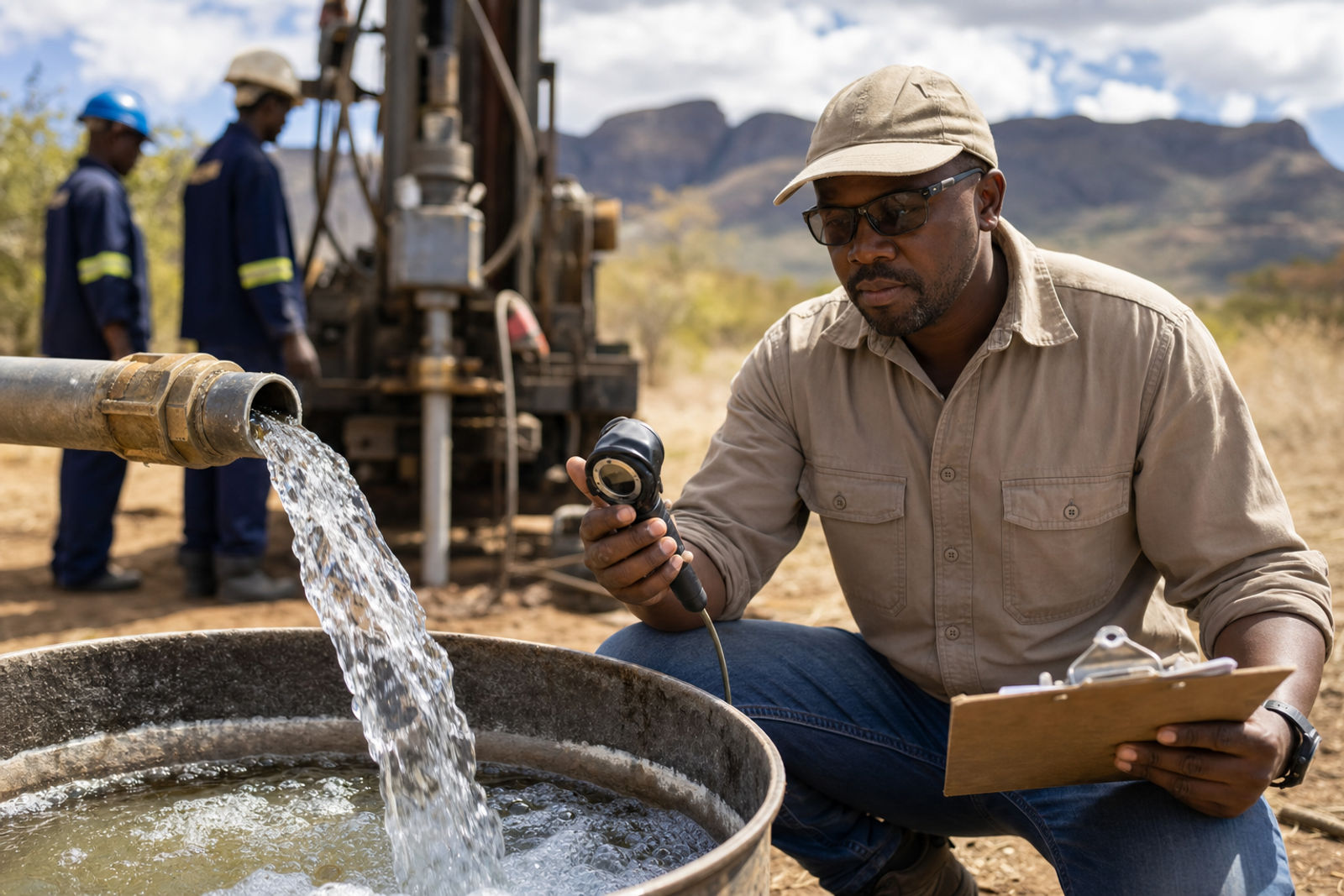
Drilling a hole is only half the job. Knowing how much water you can safely extract without depleting the aquifer is crucial — and that's exactly what yield testing determines. Without it, you're flying blind: you might pump your borehole dry within months, damage the aquifer, or install a pump that's completely wrong for your supply.
This guide explains exactly what happens during a yield test, what the numbers mean, and how to use the results to make informed decisions about your borehole system.
What Is Yield Testing?
A yield test (also called a pump test or aquifer test) measures how much water your borehole can produce sustainably over time. It involves pumping water out at controlled rates while measuring how the water level responds.
The test produces three critical data points:
- Maximum yield: The highest rate at which water can be extracted (measured in litres per second, l/s)
- Sustainable yield: The rate at which water can be extracted indefinitely without depleting the aquifer (typically 60–70% of maximum)
- Recovery rate: How quickly the borehole water level returns to normal after pumping stops
Static Water Level vs. Dynamic Water Level
Understanding these two measurements is fundamental to interpreting yield test results:
- Static Water Level (SWL): The depth at which water naturally sits when no pumping is occurring. This is your borehole's "resting" level.
- Dynamic Water Level (DWL): The depth to which the water drops during active pumping. The harder you pump, the lower it goes.
The difference between SWL and DWL is called the drawdown. If you pump too fast, the drawdown reaches the pump intake — and the pump runs dry. This is why yield testing is essential: it determines the maximum safe pumping rate that keeps the DWL above the pump at all times.
Example
A borehole in Fourways might have a static water level at 15 meters. During pumping at 1.5 l/s, the dynamic level drops to 35 meters (drawdown of 20 meters). The pump is installed at 50 meters, leaving a 15-meter safety margin. This is a healthy, sustainable setup.
Why 4-Hour vs. 24-Hour Tests?
Two main test durations are used in South Africa, each with different applications:
4-Hour Step Test
A step test involves pumping at increasing rates (e.g., 0.5, 1.0, 1.5, 2.0 l/s) for one hour at each step. This test identifies the borehole's maximum yield and the relationship between pumping rate and drawdown.
Best for: Most residential boreholes in stable geologies like the Sandton granite belt.
24-Hour Constant Discharge Test
A constant discharge test pumps at a fixed rate for 24 hours, then monitors recovery. This test proves the borehole can sustain long-term extraction — essential for high-demand applications.
Required for: Commercial use, agricultural boreholes, or high-risk dolomite areas like Centurion where sustained pumping can trigger ground instability.
The "Safe Yield" Calculation
We don't just give you the maximum flow; we calculate the safe yield — typically 60–70% of the maximum. This safety margin ensures your borehole lasts for decades, not just months.
The safe yield accounts for:
- Seasonal variation: Water tables naturally drop during dry winters and recover during summer rains
- Long-term aquifer health: Pumping at maximum depletes the aquifer faster than it recharges
- Pump protection: Operating below maximum reduces pump wear and extends lifespan
- Neighbour impact: Over-pumping can lower the water table for surrounding boreholes
Safe Yield by Geology
Different geological formations produce vastly different yields:
- Granite (Sandton, Fourways): Typically 0.5–6.8 l/s. Water is stored in fractures — yields are moderate but reliable.
- Dolomite (Centurion, Irene, parts of the West Rand): Can produce 5.0–45.0 l/s. Exceptional yields but requires specialist management.
- Shale/Karoo (East Rand): Usually 0.5–2.0 l/s. Lower yields but shallow water tables keep drilling costs down.
For detailed geology and yield data by suburb, see our Gauteng cost breakdown.
Interpreting Your Yield Test Results
Your yield test report should include these key data points. Here's what to look for:
- Yield above 0.5 l/s: Sufficient for most residential homes
- Yield above 1.5 l/s: Excellent for residential, suitable for small commercial use
- Yield above 5.0 l/s: High-capacity — suitable for agricultural and large commercial applications
- Recovery rate above 80% in 2 hours: Indicates a well-connected, healthy aquifer
- Drawdown less than 50% of borehole depth: Provides adequate safety margin
Frequently Asked Questions
What yield do I need for a residential home?
Most residential homes require 0.5–1.5 l/s depending on garden size and household requirements. A yield of 0.5 l/s provides approximately 4,000 litres over an 8-hour pumping cycle — sufficient for a 4-bedroom home with a medium garden.
How much does a yield test cost?
A 4-hour step test costs R1,500–R3,000. A 24-hour constant discharge test costs R3,000–R8,000. Most residential contractors include a basic yield test in their drilling package. See our cost guide for details.
What if my yield test shows low results?
Low yield doesn't necessarily mean a failed borehole. Options include hydro-fracturing (R15,000–R30,000) to improve flow, installing a smaller pump matched to the yield, or using the borehole for non-drinking purposes (irrigation, pool top-up). A second drill point may also be considered.
Can yield change over time?
Yes. Yield can decrease due to natural silting, mineral scaling, or declining aquifer levels. It can also increase after significant rainfall seasons. Annual monitoring helps detect changes early. Consider a smart monitoring system for real-time tracking.
Ready to Start Your Borehole Project?
Connect with verified contractors in your area. Get a free site assessment and personalised quote.
Related Guides
Related Articles
How to Finance a Borehole in South Africa: Cash, Home Loan, or Personal Loan?
A complete guide to borehole financing options in SA — home loan readvance, personal loans, pension-backed loans and cash. Real 2026 rates from FNB, Absa, Nedbank and Capitec compared.
Getting StartedThe Gautrain Borehole Incident: What Every SA Homeowner Must Know Before Drilling
In February 2025, an unauthorised borehole in Killarney caused R1 million in Gautrain tunnel damage and a 10-day service suspension. Here's what the law actually requires — and how to drill safely and legally in 2026.
Getting StartedTop 5 Reasons Why a Borehole is the Best Investment for Your SA Home
From water independence and cost savings to increased property value, here's why thousands of South African homeowners are investing in boreholes — and how to calculate your potential return.