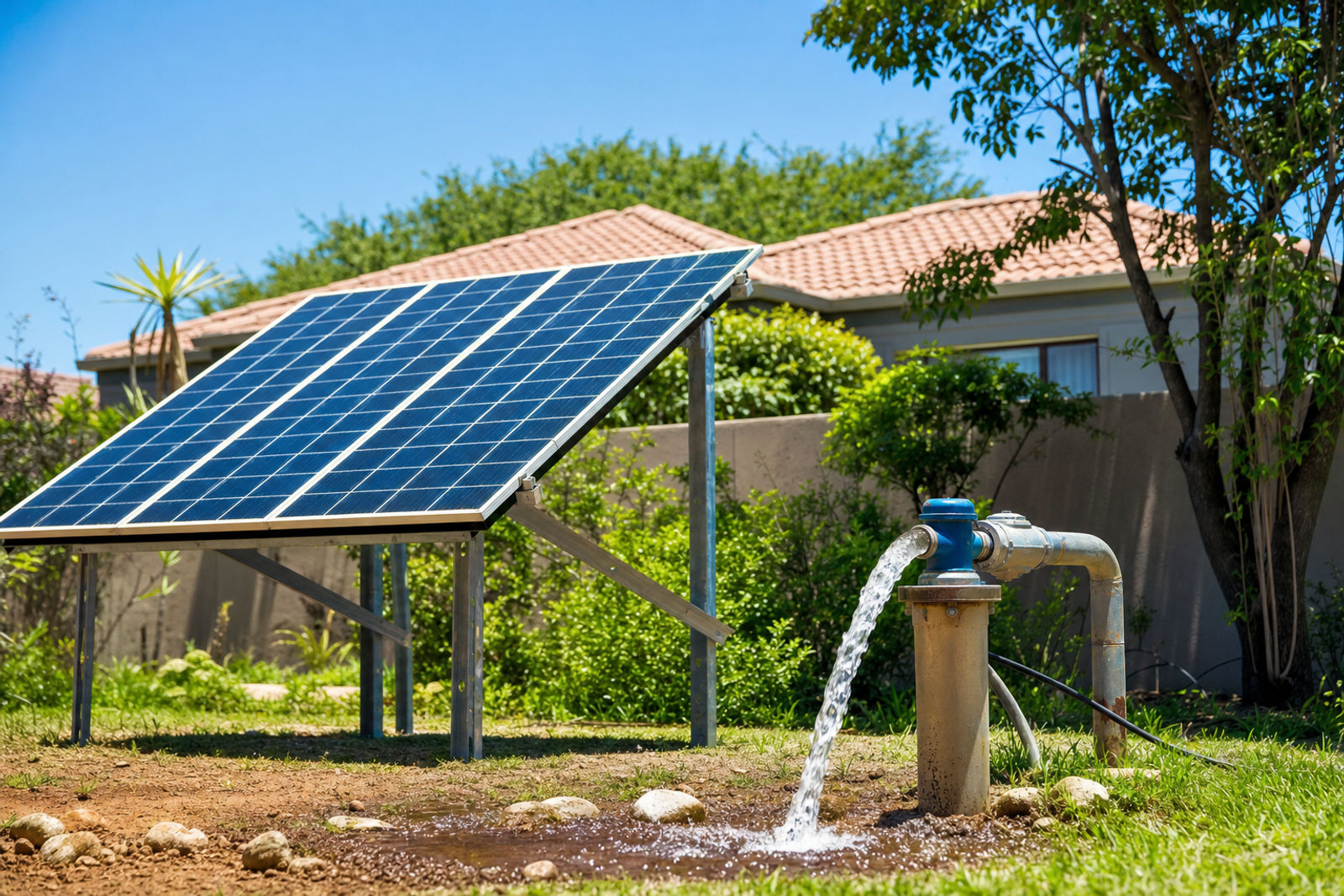
Load shedding has made solar-powered borehole pumps one of the fastest-growing categories in South Africa's water sector. A borehole without electricity is useless — but a solar pump keeps water flowing regardless of Eskom's schedule. This guide covers everything you need to know before buying.
Why South African Homeowners Are Switching to Solar Borehole Pumps
The case for solar borehole pumps in South Africa is unusually strong compared to most other countries:
- Load shedding resilience: A solar pump with a battery backup or pressure tank continues delivering water during Stage 2–6 load shedding.
- Rising electricity costs: Eskom tariffs have increased 200%+ over the past decade. A submersible pump running 4 hours/day can cost R400–R900/month on grid power. Solar eliminates this cost entirely.
- Solar resource: South Africa receives some of the highest solar irradiance in the world — 4.5–6.5 peak sun hours per day across most of Gauteng, Western Cape, and KZN.
- No grid connection required: Remote properties, farms, and new developments can drill a borehole and pump water without any electrical infrastructure.
How Solar Borehole Pump Systems Work
A solar borehole pump system has four main components:
1. Solar Panels (PV Array)
Mounted on a roof, pole, or ground frame — panels convert sunlight into DC electricity. For borehole pumping, 2–6 panels (400W each) is typical for a residential system. Panels are rated in watts peak (Wp) — a 400Wp panel generates up to 400W under ideal conditions.
2. Solar Pump Controller / Inverter
The controller converts panel output (variable DC) into the correct voltage and frequency for the pump motor. Quality controllers include dry-run protection, over-current protection, and MPPT (Maximum Power Point Tracking) to extract maximum energy from the panels throughout the day. This component is critical — cheap controllers are the most common cause of solar pump failures.
3. Submersible Pump
The same submersible pumps used in grid-powered systems can often run on solar, provided the controller is matched to the pump's power requirements. Dedicated DC solar pumps (like Grundfos SQFlex) are optimised for variable voltage and run on as little as 1–2 panels. AC pumps require a solar inverter and are generally less efficient in solar-direct configurations.
4. Storage Tank (Recommended)
Solar pumps work best when paired with a storage tank (JoJo or similar). The tank fills during daylight hours; your pressure pump then draws from the tank on demand, day or night, during load shedding, and on cloudy days. A 2,500L–5,000L tank is typical for residential use. For large properties, 10,000L+ tanks are common.
How to Size a Solar Pump System for Your Borehole
Sizing depends on three things: your daily water demand, your borehole's yield, and your borehole's depth (which determines pump head).
Step 1 — Calculate Daily Water Demand
Use 200L/person/day as a baseline for domestic use. Add irrigation requirements if applicable (a 100m² lawn needs approximately 5–10L/m²/watering = 500–1,000L per session). A household of 4 with a medium garden typically needs 1,500–3,000L/day.
Step 2 — Check Your Borehole Yield
Your yield test certificate will show your sustainable yield in litres per second (l/s) or cubic metres per hour (m³/h). A 0.5 l/s yield = 1,800L/hour = 10,800L over a 6-hour solar day. Even a low-yield borehole can supply a household if paired with a large enough storage tank.
Step 3 — Determine Total Dynamic Head (TDH)
TDH = static water level + drawdown + friction losses + height to tank. For a typical Sandton borehole at 70m depth with a 10m water table drawdown and 20m height to a rooftop tank, TDH ≈ 100m. Higher TDH requires more powerful (and more expensive) panels and pumps.
Step 4 — Size the Solar Array
As a rule of thumb: 100–150Wp of solar panels per 10m of TDH for a 0.5–1.0 l/s pump. For a 100m TDH system, budget for a 1,200–1,500Wp array (3–4 × 400W panels). Your installer should provide hydraulic calculations — insist on this before signing any quote.
Costs & Payback
Solar borehole pump systems cost more upfront than grid-powered equivalents, but eliminate ongoing electricity costs.
- Basic DC solar pump system (shallow borehole, 2 panels, small tank): R18,000–R35,000
- Mid-range system (3–4 panels, 2,500L JoJo tank, quality controller): R35,000–R65,000
- Full residential system (4–6 panels, 5,000L tank, pressure pump, filtration): R65,000–R120,000
Against a grid-powered pump costing R400–R900/month in electricity, even a R65,000 solar system pays back in 6–13 years purely on electricity savings — and panels have a 25-year lifespan. Add in load shedding resilience and the calculation shifts significantly in solar's favour.
Use our ROI Calculator to model your specific scenario with solar vs grid pump options.
Best Solar Pump Brands Available in SA 2026
Grundfos SQFlex
The gold standard for solar borehole pumps in South Africa. Designed for variable voltage (solar-direct), runs on as little as 1 panel, handles 0–300m head. SABS-approved. Expensive (R8,000–R25,000 for the pump alone) but has a 15+ year track record. Best for high-reliability applications.
Lorentz PS2
German engineering, widely used in agricultural and commercial applications across Africa. Excellent controller technology with remote monitoring. Available through authorised distributors in JHB, Cape Town, and Durban.
Franklin Electric SubDrive Solar
Popular mid-range option that adapts standard Franklin AC submersible pumps for solar operation. Good availability of spare parts through Franklin's SA distributor network. R12,000–R30,000 installed.
Chinese OEM Systems (DAB, LEO, etc.)
Budget options starting from R5,000 for a complete kit. Quality varies significantly — some perform well for 3–5 years; others fail within months. Suitable for low-head, low-volume applications (farm troughs, secondary irrigation) where downtime is acceptable. Not recommended as a primary household water supply.
Installation, Commissioning & Maintenance
Solar pump installation should be done by a qualified electrical contractor (ECSA-registered for systems above 1kW). Key installation steps:
- Panel mounting — angle optimised for your latitude (typically 26–30° tilt in Gauteng)
- Cable sizing — undersized cables cause significant efficiency losses and overheating
- Controller programming — set correct pump parameters, dry-run protection threshold, and float switch wiring for tank shutoff
- Pressure testing — run the system for 30 minutes at full output before commissioning
Annual Maintenance Checklist
- Clean panel surface (dust accumulation reduces output by 5–15%)
- Check all DC cable connections for corrosion
- Inspect borehole head seal
- Test dry-run protection trigger
- Check tank float switch operation
- Review controller fault logs
Find contractors who specialise in solar borehole installations through our contractor directory. When requesting quotes, ask specifically about MPPT controller brand, cable sizing calculations, and warranty terms on both pump and panels.
Frequently Asked Questions
Will a solar pump work during load shedding?
Yes — provided there's sunlight. A solar-direct system pumps water whenever the sun shines, regardless of Eskom. Paired with a storage tank, you can have water available 24/7. For cloudy days or overnight supply, a battery backup (adding R15,000–R40,000) provides continuous pressure from stored energy.
Can I convert my existing grid-powered borehole pump to solar?
Often yes. If your existing submersible is a 3-phase AC pump, it can typically be run from a solar inverter/VSD combination. Single-phase pumps can also run from solar. The key is matching the inverter capacity to your pump's kW rating and ensuring the solar array is large enough. A qualified installer can assess your existing setup.
How many solar panels do I need for a borehole pump?
Typically 2–6 panels (400W each) for residential boreholes. The exact number depends on your pump's power requirements and your borehole's depth (TDH). A 750W pump at 80m TDH needs approximately 4 × 400W panels for reliable full-day pumping. Your installer should provide a hydraulic calculation.
What size JoJo tank do I need with a solar pump?
Size your tank to hold at least 2 days' worth of your daily water demand, to buffer against cloudy days. For a family of 4 using 1,200L/day, a minimum 2,500L tank is recommended; 5,000L gives comfortable 4-day reserve. For properties with irrigation, 10,000L+ is common.
Is a solar borehole pump worth it in South Africa?
For most Gauteng, Western Cape, and KZN homeowners — yes. The combination of high solar resource, persistent load shedding, and rising Eskom tariffs makes the financial case strong. Payback periods of 4–8 years are realistic for full systems, with 25-year panel lifespans meaning 15+ years of essentially free water pumping.
Ready to Start Your Borehole Project?
Connect with verified contractors in your area. Get a free site assessment and personalised quote.
Related Guides
Related Articles
Smart Boreholes: Using IoT Technology to Monitor Your Water System
Real-time monitoring technology is now affordable for residential borehole owners. Discover how IoT systems can alert you to leaks, pump failures, and depleting water levels before they become expensive problems.
GuidesHow to Finance a Borehole in South Africa: Cash, Home Loan, or Personal Loan?
A complete guide to borehole financing options in SA — home loan readvance, personal loans, pension-backed loans and cash. Real 2026 rates from FNB, Absa, Nedbank and Capitec compared.
Getting StartedThe Gautrain Borehole Incident: What Every SA Homeowner Must Know Before Drilling
In February 2025, an unauthorised borehole in Killarney caused R1 million in Gautrain tunnel damage and a 10-day service suspension. Here's what the law actually requires — and how to drill safely and legally in 2026.